TW: This article mentions some topics which may be sensitive to some people.
In honour of Halloween, we’re taking a look at the challenges of selling haunted houses and other stigmatized properties.
A “stigmatized” property is a home psychologically and reputationally impacted by events like an alleged haunting, a suicide, or a violent crime. Selling these properties can be challenging because the “stigma” is entirely subjective. While some wouldn’t want to step foot onto the property, let alone own a home that was the scene of a terrible tragedy, others overlook a property’s past in exchange for a discount in the purchase price.
Will the seller tell you that the house is haunted? Legally, property flaws are divided into two categories:
-
Patent Defects: Visible flaws (e.g., a cracked window, sloping floors). The seller does not have to point these out; the burden is on the buyer to see them during their showing or inspection of the property, as long as they are not purposefully hidden.
-
Latent Defects: Hidden, physical issues that make a home unsafe or uninhabitable (e.g., toxic mould behind drywall, faulty wiring). These are defects that may cause a buyer to reconsider moving forward with their purchase. Sellers must disclose latent defects.
Because a ghost does not physically degrade the building or compromise its structural safety, a seller does not have to mention anything to any potential buyer about their belief that they’ve been living with spirits.
While you don’t have to volunteer the information, sellers cannot lie (or misrepresent) if asked directly. Agents in Ontario are held to a higher standard in that they must disclose material facts that impact a home’s property value. If the agent knows the property has a highly publicized stigma that may negatively affect its value, the agent faces a dilemma: disclose the information to potential buyers to avoid regulatory penalties, even if it goes against the seller's wishes.
Selling a haunted house faces a number of challenges:
-
Smaller buyer pool - A significant percentage of buyers will flatly refuse to live in a home associated with ghosts, murder, or suicide.
-
Longer time to sell - These homes take much longer to sell, and often invite low-ball offers.
-
Discount of potentially 10-25% compared to identical un-stigmatized homes.
-
Financing and Insurance - If a stigma becomes highly publicized, some lenders, appraisers and insurers may hesitate to get involved, citing lower liquidity.
Even those who don’t believe in the paranormal may engage in traditions and rituals to bless a new home, perform energy-changing gestures in each room, or may place certain things at the door to create a barrier to keep evil spirits out. So if owning a house that comes with its own live-in shadowy roommates is not for you, be sure to ask the seller directly if the property is considered to be haunted and do your research. A simple Google search will save you from finding out on moving day, when the neighbours gather around to meet the person who was brave enough to buy the house.
Some notable sales of “creepy” houses in the GTA:
-
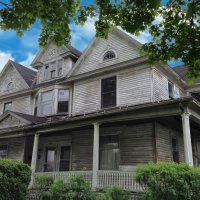
The Junction Victorian Spooky House: Located on St. John's Road overlooking Malta Park, this massive, 1891-built Victorian made headlines when it hit the market for $1,999,999 in 2022. Featuring striking gabled slate roofs, three winding oak staircases, and beautiful but heavily aged stained glass, the house felt straight out of a classic horror movie. It required up to $1 million in structural renovations to reverse decades of wear, drawing massive interest from locals obsessed with its beautifully eerie, Gothic vibe.
-
The Willowdale 'Crime Scene' House: Located at 12 Warwick Castle Court, this property went viral when it sold for $560,000 in 2019. The home captured the internet’s dark imagination because the listing photos looked less like a real estate showcase and more like a set from a horror film, complete with severe water damage that left deep blood-red stains across the floor, peeling retro wallpaper, and a basement with a stark outline that resembled a classic chalk outline. It was the ultimate eerie fixer-upper.
Outside the GTA:
-
The Dresden Victorian Funeral Home: A Toronto family looking for more space bought a 150-year-old, 38-room Victorian funeral home in Dresden, Ontario for $599,999 back in 2022. The property is widely known for its paranormal history, and the new owners openly share that the house came with "friendly ghosts." They routinely hear unexplainable footsteps, music drifting up from the basement, and a female voice saying "hello," prompting the family to establish playful "non-engagement rules" for their new extended family. They turned the property into their dream home.
-
The Peter Grant Mansion: Known as Canada's largest abandoned home (a decaying 65,000-square-foot estate on Lake Temiskaming), this sprawling mega-mansion was bought by a numbered Toronto-based company. It is heavily associated with local lore due to its skeletal, concrete-and-glass frame, subterranean boathouse, and eerie, half-finished halls that have sat dark since 2004.


Post a comment